JudaicaHQ field guide
Buying a Kosher Mezuzah: Scroll, Case, and Where It Goes
What makes a mezuzah scroll kosher, how to buy one you can trust, how often it needs checking, and where it goes on the doorpost, in plain English for first-time and experienced buyers.
Published September 22, 2026 · Updated September 22, 2026
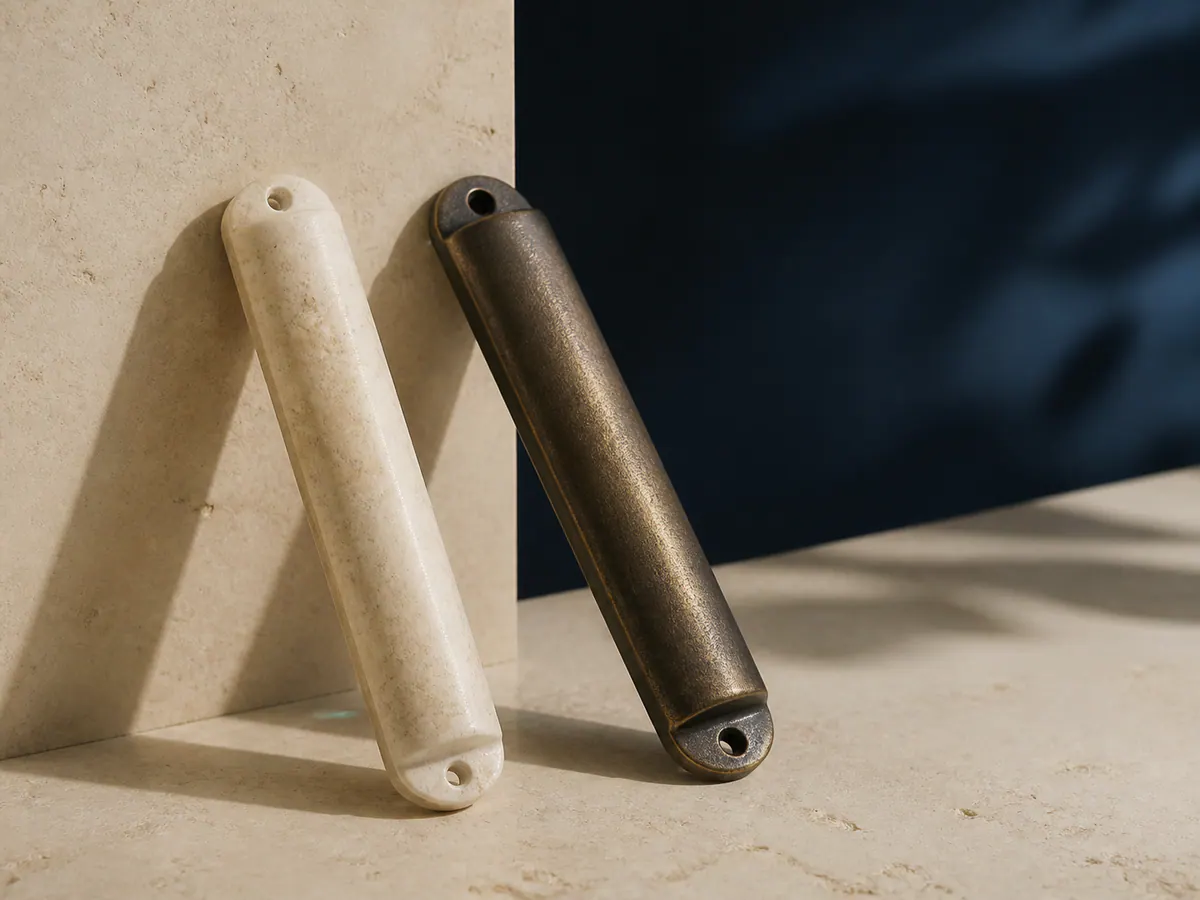
A mezuzah is one of the most common Judaica purchases, and one of the easiest to get wrong. The beautiful case in the shop window is not the mitzvah. The mitzvah is the small rolled parchment inside it.
Quick checklist
- Buy the scroll first, then the case. Put your budget into the parchment, not the housing.
- Handwritten on parchment by a sofer. A printed or photocopied scroll does not fulfill the mitzvah.
- Buy from a trusted, G-d-fearing source who can tell you who wrote and checked the scroll.
- Make sure it was checked before it goes up. A reliable seller has an expert examiner check each scroll; ask. A computer check is an extra, not a replacement.
- Have them checked again (usually by a sofer) twice every seven years for a private home (about every three and a half years).
- Right doorpost, upper third, securely attached. Ashkenazim slant it; Sephardim hang it upright.
- Say one bracha before putting up the first mezuzah, on a doorway that clearly requires one, meant to cover all the ones you're putting up now.
The scroll is the mezuzah
The mezuzah scroll, called the klaf (parchment), carries two passages from the Torah: Deuteronomy 6:4-9 and 11:13-21. They are the first two paragraphs of the Shema.[9] Traditionally the name Shaddai is written on the back.
The case just protects the scroll. A lovely case with an invalid scroll inside is not a kosher mezuzah, so invest in the scroll, not the look of the case.[3]
What makes a scroll kosher
A kosher mezuzah scroll is:
- Written on parchment made from the hide of a kosher animal.
- Handwritten in black ink with a quill by a sofer (a trained, observant scribe).
- Complete and correct. The text has 713 letters, and each one has rules for how it is formed. If even one letter is missing or shaped wrong, the whole scroll is invalid.
Scribal traditions differ. There are several accepted styles of lettering, such as Beis Yosef, Arizal, and Vellish. A person fulfills the mitzvah with any of them.[8] Roughly, Beis Yosef is used by most Ashkenazim, Arizal by Chassidim, and Vellish by Sephardim. Many families keep to the style of their community, so if you have a family custom, tell the seller.
Red flags: printed, fake, and "too cheap" scrolls
Most of what can go wrong with a scroll is invisible to an untrained eye, and that is why fraud happens.
- Printed scrolls are not kosher. Some printed mezuzos are made to look handwritten.[6] Cases have even been sold with a photocopied paper scroll inside, or with nothing inside at all.[3]
- "Checked" stamps can be a problem. Stamping or embossing the word "checked" (nivdak) on the scroll itself adds letters beyond the prescribed text and can invalidate it.[6]
- Be wary of very low prices. An experienced sofer spends hours on one scroll, so don't be surprised by the cost of that skilled work.[6] A very cheap "mezuzah with scroll" deal deserves questions.
Buy from a reliable source, and get it checked
The main protection is who you buy from. Buy from a trusted, G-d-fearing source, ideally a reliable sofer or a seller who works directly with one.[3][6] If you can, ask to see the scroll before you buy, and ask who wrote and checked it. Neat-looking writing is not proof that a scroll is kosher, so the seller's reliability and a proper check matter more than your own impression.
Before a scroll goes up for the first time, it should get a careful letter-by-letter check by an expert examiner.[8] Reputable sellers have a second scribe inspect each mezuzah before sale, so this usually happens at the seller.[3]
Computer checking is a helpful extra. Software is good at catching missing, extra, or misplaced letters, which even careful scribes can miss. But it mostly can't see a malformed letter, so a trained human examiner still has to decide whether the scroll is kosher.
Checking twice in seven years
Parchment and ink wear over time: letters crack, ink flakes, and moisture or heat do damage. The Shulchan Aruch (Yoreh De'ah 291:1) requires:
- Private homes: check each mezuzah twice every seven years, about once every three and a half years.
- Public buildings: twice in fifty years.[7]
Many people check every year during Elul, the month before Rosh Hashanah. Check every mezuzah in the home, not a sample. One exposed to rain or direct sun should be checked more often.
Some leading authorities (Rabbi Shlomo Zalman Auerbach and Rabbi Yosef Shalom Elyashiv) hold that a scroll sealed well in plastic, and not exposed to heat or anything else that could damage it, doesn't need these routine checks.[8][1] Opinions differ, so ask your rav before relying on it.
If a mezuzah will be down overnight or longer while it's checked, put up a replacement in the meantime. Opinions differ on whether to say a bracha on the replacement, so ask your rav.
Which doorways need a mezuzah
Each doorway into a proper room needs its own mezuzah. The classic conditions are two doorposts and a lintel, leading into a roofed, permanent living space at least four by four amos (cubits). That's about 7 feet (roughly 2 meters) on each side.[1] The exact figure depends on which measurement of the amah your community follows, so ask your rav about a borderline space.
- Yes: front and back doors, bedrooms, and most rooms, including many hallways.
- Without a bracha: storage rooms. Some include garages here too.[5]
- Walk-in closets: a large one needs a mezuzah, but opinions differ on whether a bracha is said; some say it goes up without one.[5] Ask your rav.
- No: bathrooms, and closets too small to count as a room.
When to put it up: outside Israel, a renter is not strictly obligated until 30 days after moving in. Many people, including Chabad custom, put mezuzos up right away without a bracha and say the bracha after 30 days.[5] In Israel, the obligation starts immediately. Whether you rent or own, and whether to say a bracha, are good questions for your rav.
Putting it up: placement basics
- Right side as you enter. For a door between two rooms, which way counts as "in" can be unclear; Chabad custom goes by the direction the door swings.[5] When in doubt, ask.
- Upper third. Place it at the bottom of the top third of the doorpost, and at least a tefach (handbreadth) below the top. On a very tall doorway, Ashkenazim go by shoulder height.[5] Sephardim keep it in the upper third regardless.
- Outer edge. Place it within the handbreadth of the doorpost closest to the outside.
- Slant or upright. Ashkenazim slant the mezuzah with the top leaning into the room. This is a compromise between Rashi, who held it should stand upright, and Rabbeinu Tam, who held it should lie flat.[9] Sephardim hang it upright.
- Attach it firmly. Nails or screws are the first choice.[5] Strong double-sided tape or glue is also used.[1] It must not hang loosely, and some authorities say not to use magnets.
- Prepare the scroll. Roll the scroll from left to right. The word Shaddai should face outward. Wrap the scroll (plastic wrap is common) before putting it in the case.
The bracha
Before attaching the first mezuzah, say:
Baruch atah Ado-nai Elo-heinu melech ha-olam, asher kideshanu b'mitzvosav v'tzivanu likboa mezuzah.
"Blessed are You, L-rd our G-d, King of the universe, Who has made us holy with His commandments and commanded us to affix a mezuzah."
If you're putting up several at once, one bracha covers them all.[2] Have them all in mind. Say the bracha on a doorway that clearly requires one, such as the front door or a bedroom, before putting up any without-a-bracha doorways. Try not to talk about unrelated things until you've finished.
Choosing a case
Once the scroll is sorted out, choose a case to your taste. Look for:
- Protection first. Outdoors, choose a case that closes well, with a solid back, to keep rain and sun off the parchment.
- The right size. Scrolls come in different sizes, so make sure the case you like fits the scroll you bought.
- Clear cases. Don't use them for bedrooms, doorways facing a bathroom, or places where diapers are changed.[3] Some authorities avoid them altogether. An opaque case is the simple choice.
- Easy to open. You'll be taking the scroll out for checking every few years.
Browse options in our mezuzah and STaM category, or find Judaica stores near you if you'd like to see scrolls in person and ask questions face to face.
FAQ
Can I buy the case now and the scroll later? Yes, but a case without a kosher scroll inside is not a mezuzah. If your budget is tight, start with a proper scroll for the front door and add more over time.[4]
Do I say a new bracha when I rehang a scroll after checking? Most authorities say no bracha is needed when the same scroll goes back on the same door.[8] If you swap scrolls between doors, a bracha is said. Ask your rav about your situation.
Can I check my own mezuzos? Most people have a sofer do the routine check, and that is the usual recommendation.[1][5] Some authorities, including Rabbi Melamed and the Chasam Sofer, allow a careful layperson to do the routine check of a scroll that was properly proofread when first bought.[8] If you're not confident reading STaM letters, or if you have any doubt, use a sofer.
A closing note
Mezuzah customs differ between Ashkenazi, Sephardi, and Chassidic communities, and even between families. This guide describes widely accepted practice. For any practical question about your home, ask your rav.
Sources
- Mezuzah – Halachipedia
- How to Hang a Mezuzah – Chabad.org
- The Mezuzah Scroll and Case – Chabad.org
- Do I Need Anything Besides the Mezuzah Case? – Chabad.org
- The Laws and Customs (Mezuzah) – Chabad.org
- Wireless Security: A Mezuzah Primer – Star-K
- Checking Mezuzos – Din Online
- From the Blessing over the Mezuzah to the Customs of the Different Communities Regarding Tefillin – Rabbi Eliezer Melamed, Yeshivat Har Bracha (Peninei Halakha)
- Mezuzah – Wikipedia