JudaicaHQ field guide
Buying a Sukkah and Schach: A Practical Guide
What to check before you buy a sukkah kit or schach: the halachic basics for walls and roofing, the main types of sukkahs sold, what the hechsher on a schach mat means, and how to size, set up and store it all.
Published September 22, 2026 · Updated September 22, 2026
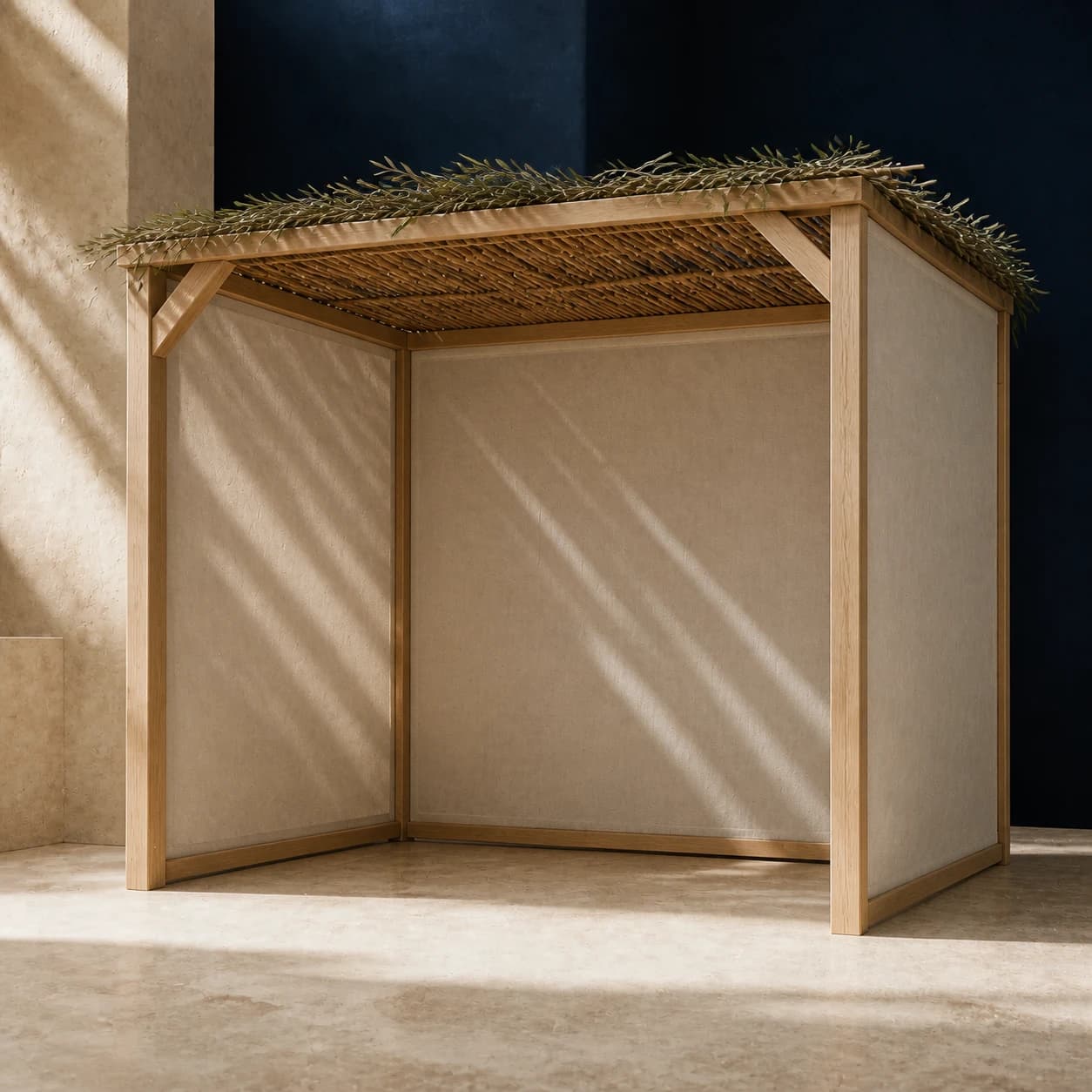
On Sukkos we move our meals, and for many families much more, out of the house and into a sukkah (a temporary hut). Building your own from lumber is still a great option. But most families now buy a ready-made kit and a roll of schach (the natural roof covering), and set it up in an afternoon. This guide covers what makes a sukkah kosher, and what to look for so the one you buy fits your family for years.
Quick checklist
- Walls that stay put. Any material works if it stands up to a normal wind. Fabric walls need to be pulled tight and fastened.
- At least three walls, though many people prefer four full walls.
- Tall enough, but not too tall. Walls at least 10 tefachim (about 31.5 to 38 inches, depending on the opinion you follow). The schach must be no higher than 20 amos (roughly 30 feet or more).
- Big enough. The floor must be at least 7 by 7 tefachim, and in practice you'll want far more room than that.
- Kosher schach. Plant material that is detached from the ground and was never made into a household item. If you buy mats, look for a reliable hechsher (kosher certification).
- More shade than sun, but not so thick that rain couldn't get through.
- Open sky above. Nothing should hang over the schach: no tree branches, balcony, awning or roof.
- Walls first, then schach.
The walls: what the halachah asks for
Materials. Walls can be made of almost anything, including wood, fiberglass, plastic, glass, mesh or stone, as long as they can stand up to a normal wind.[7][11] You can also use a wall that is already there, like the side of your house or garage, as one or more of your sukkah walls.[11]
How many. A sukkah needs a minimum of three walls. Technically, two full walls plus a small piece of a third can be enough. The details are specific, and kits are rarely designed that way anyway. One recommended approach is two complete walls plus a third at least 7 tefachim long.[7] Four complete walls are preferable, though not required, and the Chayei Adam holds the same.[1][7] When comparing kits, check how many full walls you are actually getting.
Height. A tefach (handbreadth) and an amah (cubit) are measured differently by different authorities. Rav Chaim Na'eh puts a tefach at about 8 cm (3.15 in.). The Chazon Ish puts it at about 9.6 cm (3.79 in.).[3][16] Here is what that means for a sukkah:
- Minimum wall height, 10 tefachim: about 80 cm (31.5 in.) according to Rav Chaim Na'eh, or about 96 cm (38 in.) according to the Chazon Ish. Any sukkah you can stand up in is far above this.
- Maximum schach height, 20 amos: about 9.6 m (31.5 ft.) or 11.5 m (38 ft.).
- Minimum floor, 7 by 7 tefachim: about 56 cm (22 in.) square according to Rav Chaim Na'eh, or about 67 cm (26.5 in.) according to the Chazon Ish. Any real sukkah is far larger.
Gaps. Walls don't have to be solid. Poles, slats or taut ropes set less than 3 tefachim apart count as a continuous wall. This principle is called lavud.[8] To be safe by every opinion, keep gaps under about 9 inches (22 cm). Ashkenazi practice is stricter when walls are made only of poles or ropes: it requires four such walls, or fabric added to three of them, while Sephardim accept three.[1] Ask your rav before relying on string or pole walls. The same applies at the bottom: a wall that leaves a gap of 3 tefachim or more above the ground is not valid. When you check a lattice panel, a mesh wall or a raised frame, those gaps are what to measure.
Fabric and canvas walls. Opinions differ here, so read closely before you buy:
- Many authorities consider tarp or canvas walls unfit because they sway, while others permit them.[1]
- One view holds that today's fabric sukkahs, which are fastened well all the way around, are kosher. Anyone who wants to be stricter can add horizontal bars or cords within 3 tefachim of each other, up to a height of 10 tefachim.[9]
- Another common guideline is to tie fabric walls tight enough that they don't move in a normal wind, and to make at least the bottom 10 tefachim from something solid.[11][12]
If your community is strict about fabric walls, ask the seller whether a canvas kit includes horizontal lavud cords or bars, or choose rigid panels instead. Keep in mind the Ashkenazi caution above about walls that rely on lavud alone.
Schach: the roof
What counts as kosher schach. Schach must meet three conditions:[2][4][13]
- It grew from the ground. Metal, plastic, nylon, glass and animal hides are not kosher.
- It is detached from the ground. Branches still attached to a living tree don't count.
- It has not been made into something that can become tamei (ritually impure). That rules out food, furniture, cloth and other woven fabric, and mats made for sitting or sleeping on.
Paper and cardboard are also invalid. Although they come from plants, they have been processed so far from their natural form that the Sages disqualified them.
Common choices are bamboo poles or slats, evergreen branches, palm fronds, reeds, corn stalks, and thin strips of unfinished lumber.
How much. The schach must give more shade than sun. It shouldn't be so dense that rain couldn't fall through, and it is best to follow the authorities who are strict about that.[5] Ideally you should be able to see some stars through it at night, though that is the preferred way rather than a strict requirement.[5] Spread the schach evenly with no open gap of 3 tefachim (about 9 inches) or more. Some give the limit as no gap larger than 9.6 inches.[11][12] A strip of invalid material 4 tefachim wide can also be a problem,[2] so ask your rav if your roof has a beam or strip of that size.
Open to the sky. A sukkah under a roof or a tree is not kosher. What invalidates it is something directly over the schach. A tall building beside the sukkah is fine, and so are thin clotheslines or wires overhead.[10] Before you order, look up at your deck or yard, and check for balconies, awnings, gutters and overhanging branches.
Walls first. Put up the walls before the schach. Ashkenazi poskim disqualify a sukkah where the schach went up first, while Sephardi poskim accept it after the fact.[1] If the schach went up first, the Ashkenazi fix is to lift each piece and lay it down again now that the walls are standing. The simple solution is the same for everyone: finish the walls, then lay the schach.
Schach mats vs. loose schach
Loose schach, like branches, bamboo poles or palm fronds, is traditional and usually cheap if you can collect it yourself. But it's messy, it has to be laid fresh each year, and it's harder to get the shade right evenly.
Rolled mats of bamboo slats are the convenient choice. They go up in minutes, cover evenly and store flat. The catch is the halachic concern above: a mat made as a household item, for lying or sitting on, is not kosher schach.[6] The strings that hold the slats together also matter. Star-K certifies mats made specifically for schach whose slats are tied with monofilament cord, similar to fishing line, because braided or twisted cord would be a problem according to Rashi, as applied by Rav Moshe Feinstein.[14] Other authorities are more lenient: most poskim accept mats tied with hemp string, and some agencies prefer strips of natural material.[2] Different certifying agencies follow different standards, so rely on a hechsher your community accepts.
So what does the hechsher on a mat mean? It means a kashrus agency has checked that the mat was made for schach and not as a household item, and that its binding meets that agency's own standard. The general advice is the same: buy mats that come with rabbinical supervision.[11][12] A plain bamboo rug or window blind from a home-goods store is not the same product, even if it looks alike.
Laying mats correctly. Lay the slats crosswise to the beams they rest on. Don't tie the mat itself down with string: if wind is a concern, lay a wooden beam, such as a 2×4, across the top and tie that down.[13][14] If your kit has a metal roof frame, cover the frame with wooden slats first and rest the schach on those.[13] Schach laid directly on metal is still kosher after the fact, but wooden slats are preferred.[2] Check whether the kit includes wooden or bamboo roof poles.
Types of sukkahs you'll see for sale
- Canvas or fabric on a metal frame. Light and quick to put up. Check the fabric-wall discussion above, and whether lavud cords or bars are included.
- Rigid panels (wood, fiberglass or composite). Sturdier in wind. They're heavier and bulkier to store.
- Wood kits and DIY lumber. Solid and customizable. Plan for weatherproofing and for storing large pieces.
- Lattice or mesh. Airy and attractive. Check that the openings are under 3 tefachim (about 9 inches). Walls made only of open slats rely on lavud, which Ashkenazi practice treats more strictly, so ask your rav if lattice is your only wall material.
- Add-on and expansion kits. Many systems let you buy an extra section later or use an existing house wall. That's a good way to start smaller and grow.
Sizing: plan for your busiest meal
Don't size the sukkah for an ordinary Tuesday. Size it for the first night, with guests. Start with your table and chairs: measure the table, then add room to pull chairs out and walk behind them. If your space allows, a modular system that you can expand later is often the most flexible buy.
Measure the site too. You need level ground, clearance from overhangs, room for the door to swing, and a clear path to the kitchen.
Setup and storage tips
- Do a trial setup before Yom Tov so you find any missing parts in time.
- Label and photograph the parts as you take the sukkah down. Next year's setup will go much faster.
- Store schach dry and breathable. Mats kept in sealed plastic in a garage or basement can collect condensation, which lets insects breed in the schach. Paper wrapping or open plastic in a dry spot is better.[15] If you're worried, unroll the mat in the hot sun for a few days and shake it out before Sukkos.
FAQ
Can I use my house as one wall? Yes. Existing walls of a home, patio or garage can serve as sukkah walls.[11] Just make sure no eave, gutter or overhang extends over the schach.
Is a bamboo rug from a home store okay for schach? Generally no. Mats made to sit or lie on are not kosher schach.[6] Buy mats made and certified for schach.
Is a canvas sukkah kosher? Authorities differ. Some consider fabric walls unfit because they sway.[1] Others accept well-fastened fabric, and suggest horizontal bars within 3 tefachim of each other up to 10 tefachim as a stringency.[9] Another suggestion is a solid bottom 10 tefachim.[11][12] Follow your community's practice and ask your rav.
A closing note
Customs differ between communities and families: Ashkenazi, Sephardi and Chassidic, and among individual households. The measurements above are given as ranges because the authorities differ. This guide is a starting point for shopping, not a halachic ruling. If you have a practical question about your space or a specific product, ask your rav.
When you're ready to compare options, browse sukkahs and sukkah supplies, or find Judaica stores near you to see kits in person.
Sources
- Halachipedia, "Building the Sukkah"
- Halachipedia, "Schach"
- Halachipedia, "Reference of Measurements in Halacha"
- Peninei Halakha, "What Materials May Be Used for Sekhakh?"
- Peninei Halakha, "The Shade Must Exceed the Sun"
- Peninei Halakha, "Planks and Mats"
- Peninei Halakha, "The Sukka Walls"
- Peninei Halakha, "The Height of the Walls and the Principle of Lavud"
- Peninei Halakha, "Sukkot with Cloth Walls"
- Peninei Halakha, "The Sukka Must Be Under the Open Sky"
- Chabad.org, "How to Build a Sukkah"
- Chabad.org, "Sukkology 101"
- Star-K, "Undercover: The Halachos of Schach"
- Star-K, "Guide to STAR-K Certified Schach"
- Star-K, "Proper Schach Storage"
- Din Online, "Sitting in the Sukkah" (tefach measurements)
- Wikipedia, "Sukkah" (background)