JudaicaHQ field guide
How to Choose Your Arba Minim: Esrog, Lulav, Hadassim and Aravos
A plain-English buying guide to the arba minim for Sukkos: what makes an esrog, lulav, hadassim and aravos kosher and mehudar, what to check before you pay, and how to keep them fresh through Yom Tov.
Published September 22, 2026 · Updated September 22, 2026
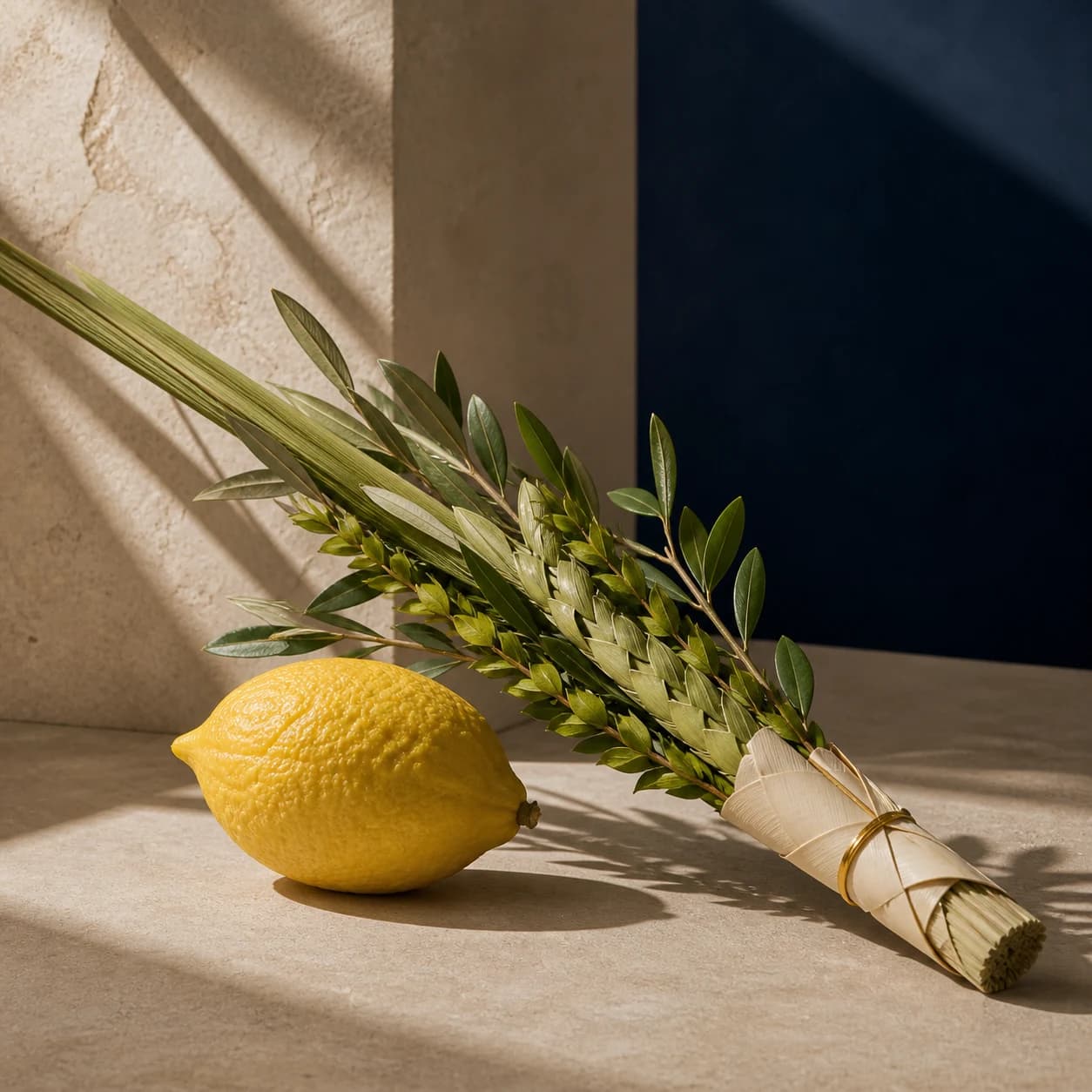
On Sukkos we take the arba minim, the four species: one esrog (citron), one lulav (closed palm frond), three hadassim (myrtle branches) and two aravos (willow branches). Buying them can feel intimidating, but you don't need a jeweler's eye to choose well. This guide explains what actually matters, in plain language.
This year Sukkos 5787 begins on the evening of Friday, September 25, 2026.[20] Because the first day is Shabbos, nobody takes the lulav that day. The first time most people will shake is Sunday, September 27.
Quick checklist
- Buy from a reliable source with a hechsher (rabbinic supervision), above all for the esrog and the lulav.
- Esrog: has its stem at the bottom, is not round like a ball, has no holes or missing pieces, and the upper part, where it starts to slope in toward the tip, is clean at a normal glance.
- Lulav: straight, green and fresh, at least the minimum length, with the center leaf at the top (the tiyomes) closed and not split.
- Hadassim: leaves grow in threes from the same point along most of the branch, and the leaves are fresh and green.
- Aravos: long, narrow, smooth-edged leaves, a reddish stem, fresh leaves, and the tip intact.
- Before Yom Tov, show the whole set to your rav or an experienced checker.
"The first day(s)": why it matters this year
Many disqualifications, such as a missing piece, a missing stem, a split tiyomes, a lack of beauty, or a borrowed set, apply only on the first day of Yom Tov. Outside Eretz Yisroel that means the first two days.[5] This year the first day is Shabbos, so outside Eretz Yisroel those stricter rules apply to Sunday, September 27, the first day you'll actually shake. Buy a set that is fully kosher for that day.
Kosher vs. mehudar: what you're paying for
A kosher set meets the halachic requirements. A mehudar (beautified) set goes further: a cleaner esrog, a straighter and fresher lulav, fuller hadassim. The Torah's phrase pri eitz hadar, "the fruit of a beautiful tree," which our tradition identifies as the esrog, makes beauty (hadar) part of this mitzvah in a way it isn't for most others.
A higher price usually buys extra beauty (hiddur), not extra kashrus. The classic guideline for hiddur mitzvah (beautifying a mitzvah) is to spend up to about an extra third over a basic kosher item.[13] That is not an obligation for someone whose finances are tight, and beautifying a mitzvah should never come at the expense of paying bills or providing for your household. A modest, clearly kosher set bought with care is a full mitzvah.
One common view adds a point for this year: when the first day of Sukkos is Shabbos, you don't need a fancy or expensive set, because the Torah requirement that the esrog be beautiful applies only on the first day.[15] Ask your rav what applies to you.
The esrog
What makes it kosher. An esrog must be at least the size of an egg (k'beitzah, roughly 50 cc).[12] There is no maximum size. An esrog that is round like a ball, or that was grown in a mold into an unnatural shape, is disqualified. Normal irregularity in shape is fine. A completely dark green esrog is unripe and not used. Light green, or green that has begun turning yellow, is fine. A black one is disqualified. It must not be dried out. An esrog left over from last year is presumed dried out, unless it was kept refrigerated or sealed (ask a rav).
Holes and missing pieces. Any hole or missing piece of the fruit is a serious problem, so show it to a rav. These defects mainly matter for the first day(s) of Yom Tov.[11] Damage that healed on the tree, or a scrape of only the thin outer peel, may be fine. Let a rav decide.
The stem and the tip. The oketz, the stem at the bottom, should be present. If it is completely gone, the esrog can't be used on the first day(s) of Yom Tov. A remnant that still covers the fruit is fine. At the top, many esrogim have a pitam, a small protrusion. Esrogim that grew without a pitam are completely kosher. The problem is a pitam that was there and broke off.[10] If you choose an esrog with a pitam, handle it gently.
Blemishes, explained simply. Where a spot sits matters more than how many there are. The upper part of the esrog, where it starts to slope in toward the tip (the chotem), is the most sensitive. A dark or unusually colored spot there that you notice at an ordinary glance is a real concern. On the rest of the fruit, a single small spot is usually not a problem, but a blemish in two or three separate places can disqualify it (poskim differ on the details), as can one spot covering most of it.[11] Show a rav anything beyond ordinary flecks. The common light yellow, gray or brown flecks that most esrogim have are normal, though a cleaner fruit is more mehudar. Tiny black dots are debated among contemporary poskim.
Grafted esrogim (murkav). An esrog from a tree grafted with a lemon or another citrus is not kosher for the mitzvah. The old visual signs of grafting are not considered reliable today, because grafted fruit can look just like a real esrog.[1][10] That is why this is the one area where the source matters more than your eye. Buy from a trustworthy seller whose esrogim come with reliable supervision. Communities have long-standing traditions (mesorah) for particular lines. Chabad chassidim, for example, value Calabrian ("Yanover") esrogim from Italy,[14] and Moroccan esrogim have a long tradition of authenticity.[1]
The lulav
Length. The spine (the central stem, not counting the leaves) must be at least 4 tefachim (handbreadths). How that converts depends on which measurement you follow: about 32 cm (12.6 in) according to Rav Chaim Na'eh, and about 38.4 cm (15.1 in) according to the Chazon Ish.[7] Ideally, when the set is bound, the spine sticks up at least a tefach above the hadassim and aravos. A taller lulav is considered a hiddur.
The tiyomes (center leaf). At the very top of the lulav is the center leaf, which is naturally doubled and joined. If most of it is split, Ashkenazim do not use the lulav on the first day(s) of Yom Tov (outside Eretz Yisroel, the first two). Some Sephardic poskim are more lenient.[6] Some people are careful to avoid even a small split, as an extra stringency. A minor split is generally acceptable. Either way, this is the lulav's most delicate point, so check it when you buy and protect it afterward: don't let the tip bang into anything.
Other things to check. The lulav should be straight, green and fresh, not dried out or yellowed. The leaves should lie closed along the spine. Leaves that have opened a little are acceptable as long as they don't droop. A spine bent like a sickle is a problem. A thin membrane sometimes wraps the top leaves (the kora). Ashkenazim generally prefer a lulav without it, because a lulav should rustle when shaken.[6]
Why the hechsher matters. Some palm fronds sold as lulavim come from the Canary Island date palm, not the ordinary date palm. Many poskim say to avoid these.[7] Buying a lulav with a reliable hechsher is how you make sure it comes from the right tree.
The hadassim
Three leaves at every level. The defining feature of a kosher hadas is that its leaves grow in threes from the same point on the stem (meshulash). A branch where the leaves grow in pairs is not a kosher hadas. The three leaves don't need to be perfectly lined up, just appear to the naked eye to come from the same height. Ideally the whole required length is threefold. At minimum, most of it must be.[8]
Length. Each hadas must be at least 3 tefachim: about 24 cm (Rav Chaim Na'eh) to about 29 cm (Chazon Ish). A mehudar hadas is thickly covered with leaves that hide the stem.
Other points. Leaves that have wilted are fine. Leaves that have completely dried out are a problem. Red or black berries that outnumber the leaves disqualify the branch. Excess berries can be picked off before Yom Tov (not on Yom Tov). A cut-off tip is best avoided.
The aravos
Identifying a real aravah. A kosher willow has long, narrow leaves with smooth (or only finely serrated) edges and, classically, a reddish stem. A look-alike with rounder, saw-edged leaves (the tzaftzafah) is not an aravah. A green stem is also acceptable, but not a white one.[4]
Length and condition. The minimum length is the same 3 tefachim as the hadassim. An aravah is disqualified if most of its leaves have dried out and lost their green color, or if most of them have fallen off.[9] Withered but still green leaves are acceptable, though fresh aravos are preferred. The tip matters: an aravah with its top cut off is not kosher. If you trim aravos to fit your holder, trim from the bottom, never the top.
When and how to buy for Sukkos 5787
- Esrog and lulav: buy early. They keep well, and shopping earlier generally means more to choose from. Since Sukkos starts Friday night, September 25, aim to have your set by Thursday, September 24, so Friday is free for cooking and the sukkah.
- Hadassim and aravos: buy as late as is practical. Aravos dry out within two or three days once cut, so they are the most perishable part of the set. It makes sense to buy them close to Yom Tov and plan to replace them during Chol Hamoed.
- Sharing a set? On the first day of Yom Tov (outside Eretz Yisroel, the first two days) you can't fulfill the mitzvah with a borrowed set. The owner can give it to you as a gift, and you give it back as a gift afterward. Ask your rav how to do this.
- Where to look. Browse arba minim and esrog sellers, or check local stores near you if you want to see and hold the esrog before you buy.
Keeping your set fresh through Yom Tov
- Hadassim and aravos: keep them in the refrigerator, wrapped in a damp towel, or in a sealed plastic case until you use them.
- This Shabbos: on Shabbos the lulav is muktzeh (may not be handled), so before candle lighting on Friday, put the set where it will stay, and don't move it until after Shabbos.[16] The esrog has its own rules.[17] Ask your rav before handling it.
- Water: if you want to stand the hadassim and aravos in water, set up the water before Yom Tov begins. On Yom Tov you may add a little water to a vase that was filled before Yom Tov, but not more than was originally there.[18] Don't change the water on Yom Tov.
- Esrog: keep it in its box, in its padding, somewhere it won't get knocked.
- Lulav: store it in its protective sleeve so the tiyomes stays closed.
FAQ
Do I need a magnifying glass to check an esrog?
No. The Mishnah Berurah sets the standard as what's noticeable at a normal glance, meaning what stands out at a cursory look.[1][11]
Is the most expensive set the most kosher?
Not necessarily. A higher price usually buys extra beauty, not extra kashrus. A reliable hechsher and a check by a knowledgeable person matter more than the price.
My hadassim and aravos wilted by midweek. Is my set ruined?
Wilting alone doesn't disqualify them. Leaves that are dried out and pale, or mostly fallen off, do. Fresh replacements are easy to find during Chol Hamoed.
A closing note
Customs vary between Ashkenazim, Sephardim and Chassidim, and between families. This guide describes generally accepted practice and notes some major differences. It is not a psak (halachic ruling). Bring your set, and any practical question, to your rav. Chag sameach!
Sources
- Etrog – Halachipedia
- Lulav – Halachipedia
- Hadasim – Halachipedia
- Aravot – Halachipedia
- What Invalidates the Four Species – Peninei Halakha
- A Split Tiyomet – Peninei Halakha
- The Requisite Size of a Lulav and a Canary Island Date Palm Lulav – Peninei Halakha
- The Hadas – Peninei Halakha
- The Arava – Peninei Halakha
- A Grafted Etrog and the Status of the Pitam – Peninei Halakha
- Deficiency and Stains – Peninei Halakha
- More Laws Concerning the Etrog – Peninei Halakha
- Hidur Mitzva – Beautifying the Mitzvot – Peninei Halakha
- How to Select the Best Lulav and Etrog – Chabad.org
- Halacha L'Maaseh on Arba Minim – OU
- Lulav on Shabbat – OU Torah
- Is an Esrog Muktzah – Shulchan Aruch Harav
- Watering the Species – Shulchan Aruch Harav
- Aravah (Sukkot) – Wikipedia
- Sukkot 2026 – Hebcal