JudaicaHQ field guide
Choosing a Tallis: Sizes, Materials, and Customs
A practical guide to buying a tallis: who wears one according to different customs, why wool is preferred, how to pick a size, atarah and stripe styles, and what to look for in kosher tzitzis.
Published September 22, 2026 · Updated September 22, 2026
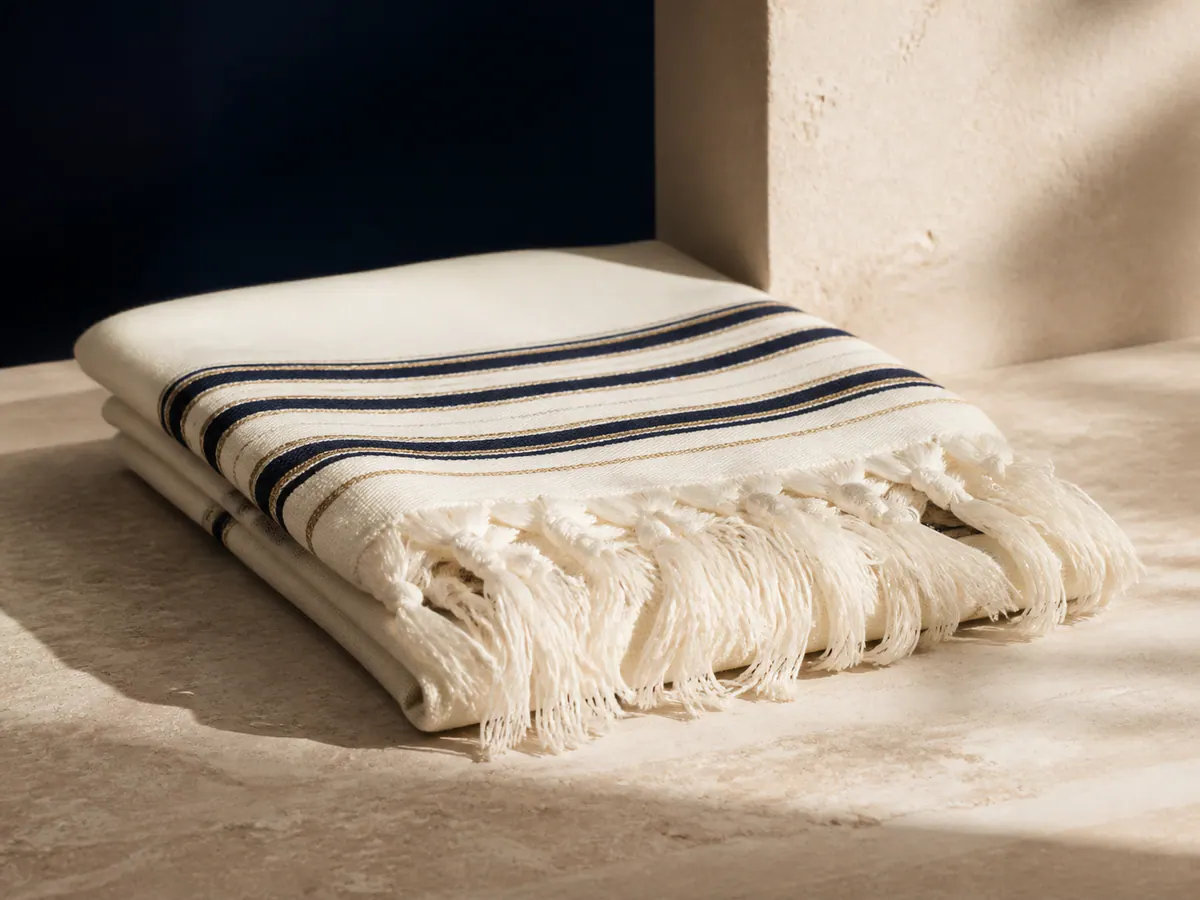
A tallis (prayer shawl, also spelled tallit) is one of the few pieces of Judaica you wear every day, often for decades. It is also a common gift for a bar mitzvah or a chassan (groom). This guide covers what actually matters when you buy one: whose custom you follow, what it is made of, how big it should be, and whether the tzitzis (the knotted fringes on each corner) are kosher.
Quick checklist
- Know your custom. Find out when men in your family or community start wearing a tallis gadol (the large prayer shawl): from bar mitzvah, or from marriage.
- Prefer wool. Many poskim (halachic authorities) consider a wool tallis the best choice. Check the label.
- Size for how you wear it. Some prefer a tallis that covers the torso, others one that wraps the whole body. If you cover your head with it, make sure it still wraps around you.
- Check the tzitzis. Look for strings made lishmah (specifically for the mitzvah), tied correctly, from a reputable seller or with a recognized kosher certification.
- Pick an atarah and stripe style that matches your community. These are matters of custom and taste.
- Add a bag to protect the tallis between uses.
Who wears a tallis gadol?
Customs differ, and it is worth asking before you buy, especially if the tallis is a gift.
- Many Eastern European Ashkenazi communities: men begin wearing a tallis gadol for daily prayers after marriage. The tallis is customarily a gift from the bride or her family. Before marriage, boys and young men wear a tallis katan (the small four-cornered garment worn under or over the shirt), and in many of these communities an unmarried man puts on a tallis gadol when he leads the prayers or goes up to the Torah.[5]
- Sephardim and Western European (for example, German) Jews: boys begin wearing a tallis gadol from bar mitzvah, and in many Sephardic communities even earlier, from the age of chinuch (when a child is old enough to be trained in mitzvos, which opinions place at roughly 3 to 9).[5]
- Other views: some authorities, such as Rav Yosef Dov Soloveitchik, held that where there is no established family custom, an unmarried young man should wear a tallis gadol.[1]
If you are not sure what your family does, ask your rav before choosing a bar mitzvah gift.
Materials: why wool is preferred
The Torah obligation of tzitzis clearly applies to a four-cornered garment of wool or linen. Garments made of other fabrics require tzitzis at least rabbinically. Ashkenazi poskim hold that other materials are included in the Torah obligation too, but still recommend wool or linen to satisfy all opinions. Sephardic practice, following the Shulchan Aruch, holds that only wool and linen garments carry the Torah obligation.[2]
In practice, a wool tallis is the standard choice. Wool on its own also avoids any question of shatnez (the prohibited mixture of wool and linen). You will also see tallisos (the plural) made of other fabrics:
- Silk and cotton tallisos also carry the mitzvah (according to the Shulchan Aruch, only rabbinically).
- Synthetic tallisos (polyester, rayon, nylon) are debated. Some authorities say a tallis should be made mostly of natural fibers, and others question whether synthetics need tzitzis at all. Ask your rav before buying a synthetic tallis.
Some practical points:
- Heat and comfort. Many poskim are lenient when wool would be uncomfortable, especially in hot weather. Several great Torah authorities, including the Vilna Gaon and the Chazon Ish, wore non-wool tzitzis garments (the small tallis katan).
- Strings. Tzitzis strings are normally made of wool, which is valid on a tallis of any fabric. Avoid linen strings on a wool tallis (shatnez). Some Sephardim prefer strings that match the tallis color.
- Leather garments do not require tzitzis at all, so a tallis is never made of leather.
Size: how to choose
Size labels vary between makers, so compare the actual width and length in inches or centimeters before buying.
How to pick:
- Decide how you will wear it. A narrower tallis sits over the shoulders and covers the torso. A full-size tallis wraps around the body. This is mostly personal and community preference.
- Allow for covering your head. If you cover your head with the tallis during prayers, make sure it is large enough to drape over your head and still wrap around your body. Try it on if you can.
- Buy for a growing bar mitzvah boy with some room to spare. A tallis bought for a chassan is usually meant to last many years.
Halachically, a tallis needs to be large enough to count as a real garment. The Gemara's standard is a garment that would cover the head and most of the body of a young child. Poskim state the minimum in amos (cubits), and they differ on the exact figure. Many Ashkenazi poskim put the practical minimum at 1.5 by 0.75 amah. The conversion to modern units also varies: Rav Chaim Na'eh's amah is about 48 cm (18.9 inches), while the Chazon Ish's is about 57.7 cm (22.7 inches). By Rav Chaim Na'eh's measure, 1.5 by 0.75 amah comes to roughly 32 by 16 inches, and it is larger by the Chazon Ish's.[2]
A standard full-size tallis gadol is well above these minimums. Very narrow, scarf-style tallisos may not be, so check the dimensions or ask your rav. The measurements matter most for a child's tallis katan.
Atarah and stripes
Stripes. Most tallisos are white or mostly white. Ashkenazi tallisos usually have black or blue stripes, which some explain as a reminder of techeiles. Many Sephardim use an all-white tallis, sometimes with white stripes. The exact pattern is a matter of custom and taste. Some communities have a distinctive look: Chabad tallisos, for example, have their own stripe pattern and no atarah. Avoid very colorful designs if you want a traditional tallis.[6]
Atarah. The atarah ("crown") is the band sewn along the top edge. It shows which way is up. Customs vary:
- Most tallisos have a plain or embroidered cloth atarah, which is the widespread custom.
- Some add an ornamental silver atarah. Most poskim see no problem with it, though some avoid it.[6]
- Many Chabad chassidim use no atarah at all.
Tzitzis strings
The tzitzis are the part that fulfills the mitzvah, so give them the most attention:
- Made lishmah. The strings must be spun for the sake of the mitzvah and tied with that intent. Strings made without this intent are not kosher, and the garment does not fulfill the mitzvah.[4][8]
- Buy from a reputable source. You cannot see whether strings were spun and tied properly. Buy from a seller you trust, or choose a product clearly labeled as certified kosher by a respected rabbinic organization.
- Length. Poskim differ on exactly how string length is measured. Commonly cited: about 12 thumb-breadths (roughly 9 inches), with the knotted section about a third of the total.[4] Pre-tied tzitzis from a reliable source will meet this. Ask a rav if strings look short.
- Check them. Look over your tzitzis before making the brachah (blessing). A string torn above the final knot can invalidate the tzitzis, so ask a rav about any damage.
Techeiles
The Torah commands a thread of techeiles (a special blue dye) in the tzitzis. Knowledge of its source was lost over the centuries. In recent decades, dye from a sea snail, Murex trunculus (also called Hexaplex trunculus), has been proposed as authentic techeiles. Poskim differ on whether to wear it. Some prominent authorities support wearing it, while many others advise against it. The overwhelming custom over the last century has been all-white tzitzis. Follow your community and rav.[3]
Tying tzitzis
Tallisos are commonly sold with tzitzis already attached. You can also buy strings separately and tie them yourself. In the standard Ashkenazi method without techeiles, each corner has eight strings and five double knots, with sections of 7, 8, 11, and 13 windings between the knots. Some communities count or group the windings differently, so if you tie your own, learn your community's method from someone experienced. Many are careful, following Rabbeinu Tam, that tzitzis for a man be tied by a Jewish man over bar mitzvah.
A tallis bag
A tallis bag keeps the tallis clean and uncrumpled between uses. Bags are often velvet (sometimes satin or leather) and are frequently embroidered with the owner's name. A bag is optional, but it is a practical addition, especially for a new bar mitzvah boy or chassan.
Where to shop
Browse tallis and tzitzis sellers in our Tallit & Tzitzit category. If you would rather see and feel the wool in person, and ask questions about sizing and tzitzis, look for a Judaica store near you.
FAQ
Is a silver atarah required? No. It is an optional decoration, and some communities intentionally avoid it.
Can I wear a tallis that isn't wool? A silk or cotton tallis with proper tzitzis carries the mitzvah, though many poskim prefer wool and some are lenient in hot weather. Synthetic fabrics are debated. Ask your rav what is right for you.
Do the stripes have to be black? No. Black and blue are both common in Ashkenazi tallisos, and many Sephardim use all white. Choose what fits your community.
My son is becoming bar mitzvah. Does he need a tallis gadol? It depends on your family's custom. In many Ashkenazi families he will wear a tallis katan until marriage. In Sephardic and some other families he will wear a tallis gadol from bar mitzvah, or even earlier.
A closing note
Customs around the tallis vary widely between Ashkenazi, Sephardic, and Chassidic communities, and between families within them. This guide describes common practice. It is not a halachic ruling. Bring practical questions about size, materials, techeiles, or tying to your rav.
Sources
- Halachipedia, "Tallit"
- Halachipedia, "Tzitzit"
- Halachipedia, "Techelet"
- Shulchan Aruch, Orach Chayim 11 (Sefaria)
- Chabad.org, "When Do Jewish Boys Begin to Wear Their Tallit?"
- Chabad.org, "Picking a Perfect Tallit (FAQ)"
- Chabad.org, "23 Tallit Facts You Should Know"
- OK Kosher, "The Laws of Kosher Tzitzis"
- OU Torah, "The Talit Gadol" (Halacha L'Maaseh)
- Wikipedia, "Tallit"