JudaicaHQ field guide
Choosing a Chanukah Menorah: Oil, Height & Materials
What makes a Chanukah menorah kosher, whether to light with oil or candles, how high the flames should be, which materials hold up, and what to buy for children, dorms, or a family heirloom.
Published October 5, 2026 · Updated October 5, 2026
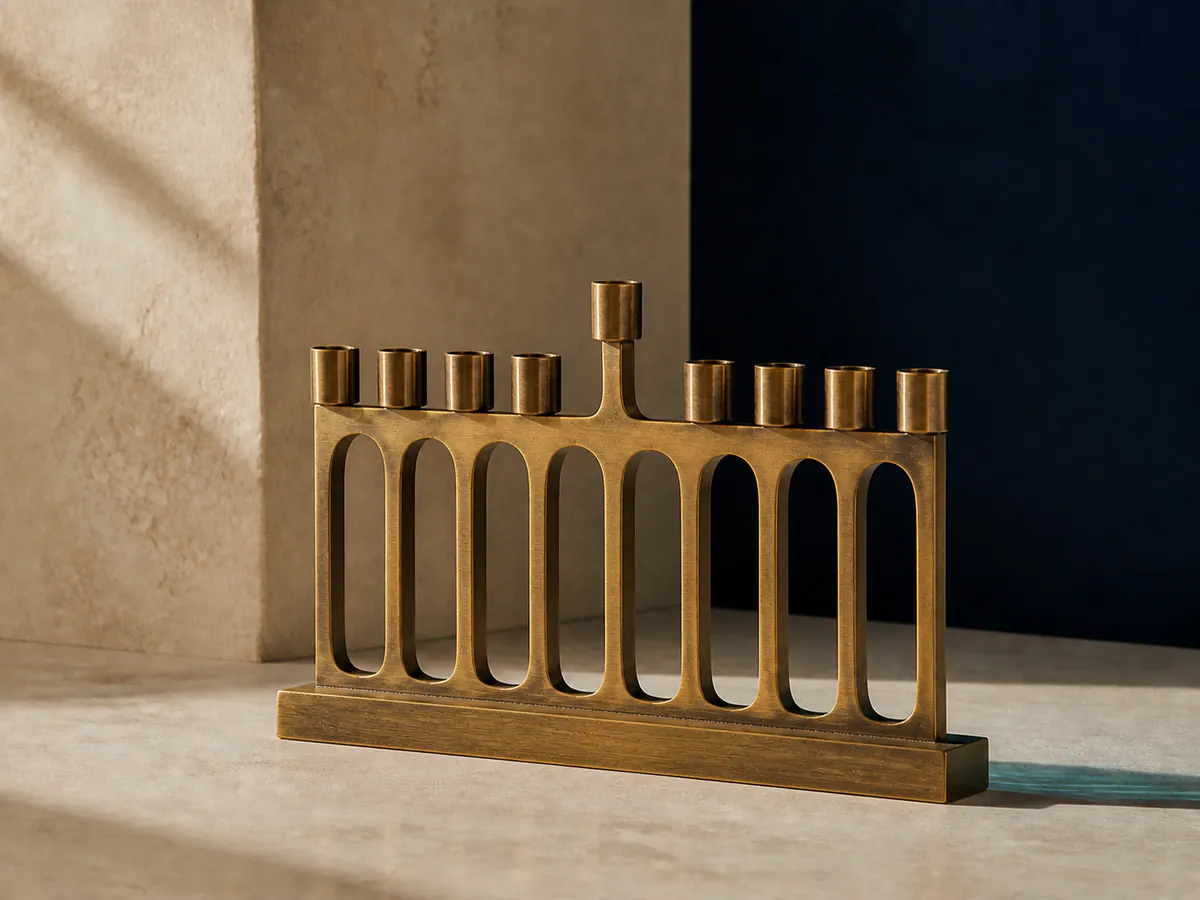
A Chanukah menorah (also called a chanukiah) looks simple: eight lights and one more. But a beautiful piece in a shop can still be a poor menorah for actually lighting. The lights may sit at different heights, the flames may crowd together, or the cups may be too small. This guide covers what matters when you buy one: the halachic basics, oil versus candles, height, materials, and what to look for when you're buying for a child, a dorm room, or the menorah your family will use for decades.
Quick checklist
- Eight lights in a straight row, all at the same height or on an even slant. No circles, no zigzags.
- A ninth holder for the shamash that is clearly set apart: higher, lower, or out of line.
- Enough space between the lights so the flames stay separate and candles don't melt each other.
- Oil is preferred; candles are fine. If you want oil, check that the menorah takes oil cups or glass inserts. Ask the seller; don't assume.
- Cups or candle holders big enough to burn at least half an hour after nightfall (about 1½ hours on Friday afternoon).
- A real flame. An electric menorah is a nice decoration, but it does not fulfill the mitzvah.
- Fire-safe and stable, especially for a child's menorah.
- Plan where it will stand. Halachic height is measured from the floor to the flames, so where you put the menorah matters as much as how tall it is.
The halachic basics
These are the main requirements most authorities agree on. Customs differ in the details, so ask your rav about your own situation.
A straight, even row
The eight Chanukah lights should stand in a straight line, not in a semicircle. They should be level, or on an even slant, not "some randomly higher than others."[2] The OU puts it this way: the lights should be "in a straight row, and even; that is, none being higher or lower than the others, none receding or protruding, and none in a circle."[5]
This rules out many sculptural designs: round menorahs, lights at scattered heights, or arms that bend in different directions. Such a piece can still be lovely art. If you're not sure whether a design works, ask your rav before it becomes your family's menorah.
The menorah does not have to be one piece. Separate holders can also work, as long as they are always set up in a straight row; ask your rav if you're unsure.[1]
A shamash set apart
A kosher menorah has eight holders plus one more, set apart from the rest, for the shamash, the "attendant" light.[1] You use the shamash to light the others, then put it back on the menorah, apart from the Chanukah lights.[2]
The shamash can sit "either above or below or in front or behind." Any difference works as long as it's obvious the shamash is not one of the regular lights.[5] Halachipedia says the shamash should sit slightly higher than the others or at a recognizable distance from them.[8] When you shop, look at the shamash holder. If it's at the same height and in line with the others, it may not stand out clearly enough.
Flames that stay separate
Each flame should look distinct to someone watching.[2] There should be enough space between them "so that the flame of one might not be joined to that of the other; and so that the heat of one candle, if candles are used, might not melt the wax of another."[5] For candles set straight onto a surface, the Mishnah Berurah (671:18) asks for at least a fingerbreadth between them.[6]
Very compact or miniature menorahs are where this goes wrong most often. Lights set too close together can merge into a single blaze, especially by the eighth night.
Height: between 3 and 10 tefachim
The ideal is for the Chanukah lights to be placed at least 3 tefachim (handbreadths) from the ground, and not more than 10 tefachim.[5] This follows the Talmud (Shabbat 21b) and the Shulchan Aruch (Orach Chayim 671:6).[7] If the lights end up above 10 tefachim, you have still fulfilled the mitzvah.[7]
In modern measurements, 3 to 10 tefachim is about 24 to 80 cm (roughly 9½ to 31½ inches) by Rav Chaim Na'eh's measure, or about 29 to 96 cm (roughly 11 to 38 inches) by the Chazon Ish's measure.[7] The outer limit is 20 amos (about 9.6 to 11.5 meters, roughly 31 to 38 feet, depending on the measure). Lights placed higher than that do not fulfill the mitzvah.[7][1]
Two practical points for buyers:
- The height is measured to the flame, from the floor.[7] A tall menorah on a typical dining table can easily put the flames above 10 tefachim. If you want to stay in the ideal range, plan where it will stand (on a low table or bench, for example) before choosing how tall a menorah to buy.
- A window can come first. If you light indoors and have a window facing the street, Halachipedia notes it is better to light by the window even if that is above 10 tefachim, rather than by the inside of the doorway.[7]
Where to light (outside the front door, at a window, or by an inside doorway) differs between communities.[2] Settle on your spot first, then buy a menorah that fits it.
Oil or candles?
Both are fine. Oil is preferred.
The best way to do the mitzvah is with pure olive oil and cotton wicks. The light is clear, and it recalls the miracle of the oil in the Temple.[3][5] Other oils and wicks can be used if they give a steady, not flickering, light. Wax or paraffin candles are also permitted.[3]
What this means when you shop:
- Oil menorahs have cups, either fixed in place or removable glass inserts. Oil takes more setup (wicks, filling, and cleaning cups and drips after Chanukah), but many families find it the more beautiful light.
- Candle menorahs are simpler and suit children and first-time buyers. Check that the holders fit standard Chanukah candles. Some menorahs need specific candle sizes.
- Convertible menorahs. Some menorahs take both candles and oil inserts, so you can start with candles and switch later. Whether a particular model takes inserts, and which size, is a question for the seller. Don't assume.
Burn time. Whatever you use, the menorah has to hold enough fuel to burn for at least 30 minutes after nightfall.[2][5] If you light before nightfall, the lights have to last longer. On Friday afternoon the menorah is lit before sunset and must still burn until half an hour after dark, about 1½ hours, so Chabad advises choosing oil cups that hold at least that much.[1] The OU notes that those who light at sunset need fuel for at least 50 minutes.[5] Very small oil cups or thin candles can fall short.
Electric menorahs can be used for decoration, but they don't fulfill the mitzvah, which requires lighting a flame.[4]
Materials
A Chanukah menorah can be made from any fire-safe material.[4] Even so, beautifying a mitzvah (hiddur mitzvah) means buying the most beautiful menorah within your means.[1][6] Holders should be of attractive metal or glass. An earthenware holder can be used only once, when it is new.[3] The Kaf HaChaim lists fifteen materials a menorah can be made of, with gold, silver, and copper at the top. Glass, wood, and china appear further down the list.[6]
- Sterling silver is the classic heirloom choice. It lasts for generations but needs polishing, and wax or oil is easier to clean off if you use drip trays or glass inserts.
- Silver-plated, brass, and other metals look traditional for less money. Plating can wear over time with heavy cleaning.
- Glass and crystal look beautiful with oil, but check that the piece is sturdy and made to take a flame.
- Ceramic, stone, and wood are common in designer and children's menorahs. With wood, check that the lights sit in metal or other fire-safe cups. With unglazed earthenware, keep the one-use rule above in mind, and ask your rav about a specific piece.
- Improvised holders such as eggshells, hollowed-out potatoes, or fruit should not be used as a menorah, because they degrade the mitzvah.[6]
Buying for a particular person
Children
In standard Ashkenazi practice, each member of the household lights their own menorah, children included.[2][5] Customs differ for women and girls; a married woman generally relies on her husband's lighting.[8] In Sephardic practice, one lighting covers the household.[8] A child's menorah should meet the same rules as an adult's: a straight row, a shamash set apart, and flames that stay separate. On top of that, look for:
- A wide, heavy base that won't tip over.
- Candles rather than oil for young children.
- Lights spaced well apart, since novelty and character designs often crowd them.
- A plan for adult supervision, and a spot well away from curtains and anything else that can burn.
House of David Judaica
Retailer · Valley Village · Online
Judaica and Jewish gift store on Burbank Blvd in Valley Village (San Fernando Valley) with an online shop: menorahs, candlesticks, challah boards and covers, kiddush and wash cups, ketubot, seder plates, sukkah sets and decor, lulav bags, haggadahs, school sefarim, and pre-wrapped gift sets; carries Michael Aram, Yair Emanuel, Godinger, ArtScroll and Waterdale.
- Services
- Personalization · Local pickup
Dorms and shared housing
Many campuses and yeshivos restrict open flames in or near dorm rooms[7]; check the rules before you buy. Ashkenazi students living away from home generally light for themselves, while Sephardic students supported by their parents are usually covered by the household lighting.[8] Authorities differ on whether lighting in a lobby or dining hall fulfills a student's obligation.[7] An electric menorah is not a substitute for the mitzvah.[4] Ask your rav, or the campus rabbi, where and how to light. A small, stable candle menorah that packs flat is usually the practical choice.
The heirloom
For the menorah your family will light for the next thirty years, look at oil (or a menorah that takes oil inserts), a solid metal such as sterling silver, and a shamash that clearly stands apart. Check the spacing on the eighth night, not the first, and plan for its full height where it will stand. Engraving with names or a date is a common personal touch. Ask the seller whether they offer it.
| Merchant | Price | Where | Services |
|---|---|---|---|
| Hazorfim | — | Online | Ships worldwide, WhatsApp orders & inquiries |
| Heritage Silver | — | Lakewood · Online | WhatsApp orders & inquiries |
Where to buy a menorah
Different kinds of stores suit different buyers:
- Local Judaica stores. You can see the spacing and shamash in person, compare heights, and ask whether a model takes oil inserts. Visit early in the season if you want the widest choice. Find Judaica stores near you.
- Silver specialists. The place to go for sterling heirloom pieces. Ask about matching drip trays or engraving.
- Artists and designers. Contemporary and handmade menorahs. Check every design against the straight-row and shamash rules before you fall in love with it.
- Museum shops. A wide range of contemporary and traditional designs, good for gifts.
- Large online retailers. The widest selection of candle and oil menorahs, travel and children's models, and accessories.

Apeloig Collection
Artist & designer · Online
Women-owned contemporary Judaica design brand with an online shop for mezuzah cases, challah boards and covers, kiddush pieces, menorahs, and Passover items.
- Services
- Engraving · Personalization
Jewish Museum Shop
Retailer · New York · Online
Official shop of The Jewish Museum in New York, selling contemporary and traditional Judaica, Jewish art and design objects, books, gifts, and holiday items online and at the museum.
Ships to the U.S.
Browse more stores in our Hanukkah menorahs category. The stores we list are chosen editorially; affiliate relationships never affect which ones appear or the order they appear in.
FAQ
Is a menorah with a curved or circular row kosher? A semicircle or circle is not acceptable. The lights should be in a straight line, either level or on an even slant.[1][2] Ask your rav about any design you're unsure of.
Can I use an electric menorah? As decoration, yes. To fulfill the mitzvah, no. A real flame is required.[4]
Is olive oil required? No. Olive oil is the ideal, but other oils with a steady flame, and wax or paraffin candles, are all permitted.[3]
How tall should my menorah be? What counts is where the flames end up: ideally between 3 and 10 tefachim from the floor, roughly 9½ to 38 inches depending on the measure you follow.[7] Choose the height to fit where you'll place it.
Does each family member need a menorah? In Ashkenazi practice, usually yes, children included.[2][5] Customs differ for women and girls; a married woman generally relies on her husband's lighting. In Sephardic practice, one lighting covers the household.[8]
Can I light candles without a menorah? Wax candles can be attached to a surface such as a ledge if they are well spaced, but using a proper menorah is best because it satisfies all opinions.[6]
A closing note
Customs around the Chanukah menorah, including who lights, where, and with what, differ between Ashkenazi, Sephardic, and Chassidic communities. This guide describes widely accepted practice. It is not a halachic ruling. For practical questions about your home or your menorah, ask your rav.
Shops in our directory
A selection of merchants listed under Hanukkah Menorahs, shown in a neutral order, not ranked.

Adi Sidler
Artist & designer · Online
Israel-based Judaica designer with an official online shop for contemporary mezuzah cases, menorahs, dreidels, Judaica, and jewelry. The site also offers custom-quantity and wholesale inquiries.
- Services
- Custom orders · Wholesale
Bier Judaica
Artist & designer · Online
Jerusalem family silversmith studio creating handcrafted sterling silver Judaica, including kiddush cups, candlesticks, menorahs, mezuzah cases, and Torah ornaments, with online purchasing routed from the official site.
Ships internationally · from Israel
Bala Judaica and Jewelry
Retailer · Bala Cynwyd
Family-run Judaica and jewelry store on Bala Avenue in Bala Cynwyd, PA, serving Philadelphia for 30+ years: tallitot, menorahs, kiddush cups, challah and seder plates, ketubahs, books, mezuzahs, candlesticks, art and jewelry, with customized tallit and special orders.
- Services
- Personalization · Custom orders
Impressive Silver
Artist & designer · Online
Monsey-based Judaica maker that designs and produces copper-filled silver pieces, including candlesticks, menorahs, kiddush cups, trays, and holiday items, sold through its online store.
Judaica Webstore
Retailer · Online
Large Jerusalem-based online Judaica and Israeli-products retailer shipping worldwide — Jewish jewelry, tallits, tefillin, shofars, mezuzahs, Israeli art, Dead Sea cosmetics, and gifts. Multi-currency checkout with a US toll-free support line.
Ships internationally · from Israel

Elite Sterling
Retailer · Brooklyn · Online
Sterling silver Judaica specialist with showrooms in Boro Park and Crown Heights, selling silver candlesticks, kiddush cups and sets, menorahs, candelabras, Torah ornaments, and silver tableware, with an online store offering free shipping.
Ships from the U.S.
Sources
- Chabad.org, "What Constitutes a Kosher Chanukah Menorah?"
- Chabad.org, "16 Menorah Facts Every Jew Should Know"
- Chabad.org, "Oil or Candles for the Menorah?"
- Chabad.org, "What Is a Menorah (Chanukiah)?"
- OU, "The Lights of Chanukah: Laws and Customs"
- OU Kosher Halacha Yomis, "Chanukah – Menorah Types" (OU Torah)
- Halachipedia, "Placement of the Chanukah Candles"
- Halachipedia, "Lighting Chanukah Candles"