JudaicaHQ field guide
Choosing a Kiddush Cup: Size, Silver, and Hallmarks
Choose a kiddush cup with enough capacity, a comfortable shape, and clearly described materials. Practical advice on silver, hallmarks, care, and gifts.
Published October 18, 2026 · Updated October 30, 2026
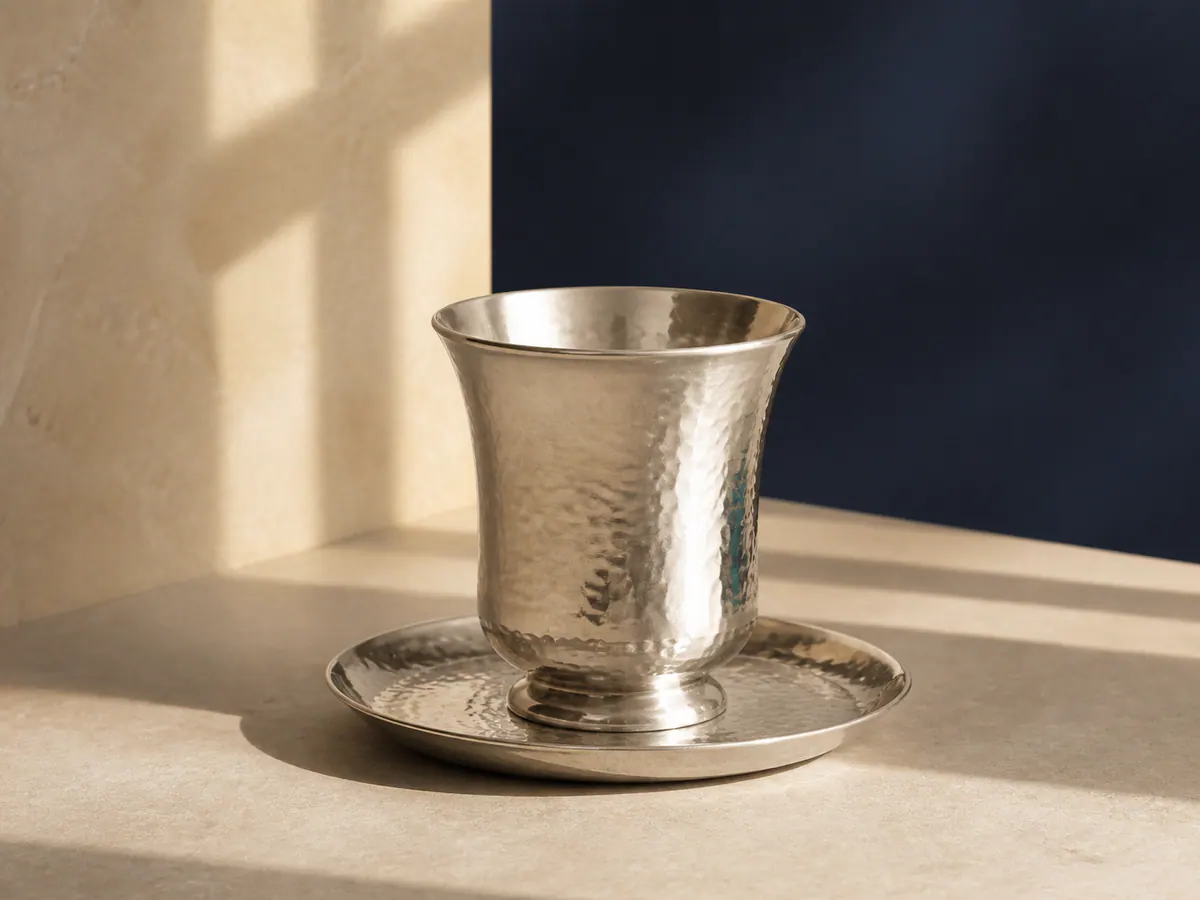
A good kiddush cup should be comfortable to use every week. Start with its capacity, then consider the shape, material, and care it will need. If you are paying for silver, make sure the seller describes exactly what you are buying.
Quick checklist
- Confirm the capacity. The cup must hold a revi'is; use the measure your family follows.
- Ask for milliliters or US fluid ounces. The weight of a silver cup tells you nothing about how much wine it holds.
- Check the rim, bowl, stem, and base. Look for cracks, chips, repairs, and wobbling.
- Try the grip. A cup that looks lovely in a photograph may be awkward to hold when full.
- Distinguish sterling, plated, and filled construction. Have the material and any filling stated on the receipt.
- Check the total price. Ask whether a saucer, engraving, and shipping are included.
How much should it hold?
A kiddush cup must hold at least a revi'is, a halachic measure of liquid. Different authorities give different modern equivalents. Confirm your family's practice before choosing a cup close to the minimum.[1]
These are commonly cited measures. The conversions below are approximate and use US fluid ounces, which measure capacity, not ounces of weight:
- Rav Chaim Na'eh, as cited by Chabad: 86 ml, approximately 2.9 US fl oz.[2]
- STAR-K's guidance: 112 ml, approximately 3.8 US fl oz.[3]
- Rav Moshe Feinstein's Friday-night measure, as cited by OU Torah: 4.42 US fl oz, approximately 131 ml.[4]
- Chazon Ish, as cited by OU Torah: 150 ml, approximately 5.1 US fl oz.[4]
You don't need to resolve the disagreement in the shop. Find out which measure you use, then choose a cup with a little room beyond it rather than buying at the exact cutoff. If it is a gift, ask the recipient's family which size they want. A cup sold as a “kiddush cup” still needs its capacity checked.
Measuring at home
Fill the cup with water to the top, then pour that water into an accurate graduated measuring vessel. Read the volume and compare it with the measure you need. A tall stem, thick walls, or a deep-looking bowl can make a cup appear larger than its usable capacity.
When ordering online, ask whether the stated capacity is measured to the rim. If a listing gives only height and width, request the volume before buying.
Does a larger cup have to be full?
The preferred practice is to fill the cup to the top for kiddush. If there is not enough wine, STAR-K allows a cup containing a revi'is even though it is not full.[3] For an everyday purchase, choose a size you will be comfortable filling and handling rather than assuming the largest cup is best.
Shape and condition
The cup should be clean and intact, without cracks or holes.[3] Check the base as well as the bowl, particularly on an antique or second-hand piece.[1]
In a shop, hold the cup as you would at the table. Check whether the stem or bowl feels secure in your hand, whether the rim is comfortable, and whether the base stands evenly. If several people will use it, consider the grip of the person who will use it most often.
A saucer helps catch spills. Check that it is large enough for the cup and included in the price if the product photograph shows a set. For a cup that will also be used for havdalah, a saucer is especially useful because of the custom to pour until the wine overflows.[5]
Choosing a material
Silver is a traditional way to beautify the mitzvah, but a glass or other suitable non-disposable cup can also be used.[3] Choose a material that suits your budget and the way the cup will be handled and cleaned.
Sterling silver
Sterling silver contains at least 92.5% silver. “925” refers to that fineness. It does not, by itself, tell you whether a piece is filled, how heavy its silver component is, or whether the mark has been independently verified.[6]
Ask the seller to describe the construction and confirm what any quoted weight includes. If you are comparing two silver cups, compare capacity and construction as well as appearance and total weight.
Silver-plated, electroformed, and filled pieces
Silver-plated pieces have a layer of silver over another material. They can give you the look you want at a lower cost, but cleaning needs care because the silver layer can wear away.[7]
“Electroformed” describes a manufacturing process rather than a complete specification. Ask what the silver fineness is, what lies underneath, and whether the piece has a filling. The description should make clear when silver is only a surface layer.[6]
For example, Impressive Silver describes its own products as silver with an internal copper structure.[8] If you are considering a filled piece, ask how much silver it contains and how it should be cleaned. Compare it as the construction it is, rather than treating its total weight as silver weight.
Glass and other materials
Glass, stainless steel, and other suitable non-disposable cups are options too.[3] For children or travel, consider handling, durability, and easy packing. Whatever the material, check for chips or cracks and make sure it is intended for drinking.
Disposable cups raise a separate halachic question and are a fallback in difficult circumstances.[3] For a planned purchase, choose a reusable cup you will enjoy using.
What the marks tell you
A mark is useful information, but different marks mean different things:
- “Sterling” or “925” describes silver fineness. Ask who made the piece and whether the mark is a manufacturer's stamp or part of an independently tested hallmark.[6]
- A British hallmark normally includes a sponsor's mark, a fineness mark, and an assay-office mark. The date letter is optional on modern pieces. A lone “925” is not the same as this full hallmark.[9]
- “800” indicates 80% silver where used as a fineness mark. It is a recognized silver standard, but it is not sterling.[9]
Ask the seller to put the material description on the receipt. For an expensive or antique cup with unfamiliar marks, have someone knowledgeable identify them before you buy.
Antique cups and special orders
An old cup may be beautiful and still be too small for the measure you use. Check its capacity, rim, base, and any repairs. On British silver, date letters can help establish age, but not every old piece carries a hallmark.[9]
For a handmade or engraved cup, confirm the capacity and dimensions before approving the order. Ask whether engraving affects returns, whether the spelling will be sent for approval, and when the cup will arrive. If you want a matching saucer or additional cups later, ask about availability rather than assuming the design will remain in production.
With a kiddush fountain, check the main cup's capacity just as you would for a single cup. Ask how the channels and small cups come apart for cleaning and what is included in the set.
Care before and after buying
Silver tarnishes, and polishing removes a small amount of material each time. Use a gentle method suited to the piece and polish only when needed; plated surfaces require particular care.[7]
Ask the seller for cleaning instructions, including whether the cup has a coating, lining, or filling that changes its care. Check that you can reach inside the bowl comfortably and dry it after washing. Avoid abrasive scouring, and get specific advice before cleaning an antique or repaired piece.[7]
Where to buy a kiddush cup
Silver specialists are useful for comparing construction, marks, and matching sets. Artists and silversmiths may offer commissions; confirm the capacity before work begins. General Judaica stores let you compare a range of materials and, in person, try the grip and weight.
| Merchant | Price | Where | Services |
|---|---|---|---|
| Elite Sterling | — | Brooklyn · Online | Ships from the U.S. |
| Bier Judaica | — | Online | Ships worldwide, Ships from Israel |

Impressive Silver
Artist & designer · Online
Monsey-based Judaica maker that designs and produces copper-filled silver pieces, including candlesticks, menorahs, kiddush cups, trays, and holiday items, sold through its online store.

Eichler's of Boro Park
Retailer · Brooklyn · Online
General Judaica superstore at 5004 13th Avenue in Boro Park, selling seforim, religious articles, silver, tallis and tzitzis, and gifts online and in person. Its official site offers US and worldwide shipping, in-store pickup, and WhatsApp ordering.
Ships internationally · from the U.S.
- Services
- Engraving · Local pickup
Browse our Kiddush Cups & Silver category, find stores near you, or explore antique Judaica dealers. Stores are chosen editorially; affiliate relationships do not affect inclusion or order.
FAQ
Does a kiddush cup have to be silver? No. Silver is a way of beautifying the mitzvah, but a suitable glass or other non-disposable cup can be used.[3]
What size should I buy as a gift? Ask which measure the family follows and choose a cup comfortably above it. Confirm capacity in ml or US fluid ounces before having it engraved.
Is a 925 stamp enough to judge the value? No. It describes fineness, but you still need to know the construction, condition, and what any stated weight includes. A documented assay hallmark provides different information from a maker's stamp.[9][6]
Shops in our directory
A selection of merchants listed under Kiddush Cups & Silver, shown in a neutral order, not ranked.
Nadav Art
Artist & designer · Online
Jerusalem silversmith Avi Nadav offers sterling silver and anodized aluminum Judaica online, including kiddush cups, Shabbat candlesticks, havdalah sets, menorahs and mezuzah cases.
Ships internationally
Feldi Studios
Artist & designer · Online
Ceramic Judaica studio offering menorahs, kiddush cups, mezuzah cases, honey pots and seder plates through its online shop. Mezuzahs are cases only; scrolls are not included.
Ships to the U.S.
Coby's Judaica
Retailer · West Bloomfield Township · Online
Judaica shop inside the JCC building on West Maple Road in West Bloomfield, MI, selling handmade Israeli-made Jewish gifts, holiday essentials, art and jewelry, including kiddush cups, honey dishes, challah boards and shofars; Shopify store with cart.
Shalom House Fine Judaica
Retailer · Woodland Hills · Online
Family-owned Judaica store in Woodland Hills (west San Fernando Valley) since 1971, selling handcrafted Judaica including menorahs, mezuzot, ketubot, kiddush cups, candlesticks, tallitot, Jewish jewelry and wall art, with a gift registry and online shop.
- Services
- Wedding registry

Hazorfim
Retailer · Online
Sterling-silver Judaica house with over 70 years of history, selling its handmade candlesticks, candelabras, menorahs, and kiddush sets online with international shipping that includes the US. Site lists a store locator, a New York-area phone line, and a WhatsApp contact channel.
Ships internationally
- Services
- WhatsApp orders & inquiries
Signature Silver
Retailer · Monsey · Online
Sterling silver Judaica specialist at 108 Route 59 in Monsey, selling silver Judaica for Shabbos and holidays through a working online shop and offering pickup at its Monsey location.
Sources
- Halachipedia, "Kiddush"
- Chabad.org, "What You Need to Know About Making Kiddush"
- Star-K, "The Halachic Guide to Kiddush"
- OU Torah, "Requirements of the Kiddush Cup" (Rabbi Eli Ozarowski)
- Chabad.org, "What Is Havdalah?"
- Legal Information Institute, "16 CFR § 23.5: Misrepresentation as to silver content"
- Canadian Conservation Institute, "Silver: Care and Tarnish Removal" (CCI Notes 9/7)
- Impressive Silver, "About Us"
- UK Assay Offices, "Hallmarking Guidance Notes" (November 2022)